

Best SEO Companies in San Antonio: 8 Top Agencies Ranked (2026)
Compare the 8 best SEO companies in San Antonio for 2026. See who each agency fits, their specialties, and how to choose the right partner for your business.
 Ahmad Rauf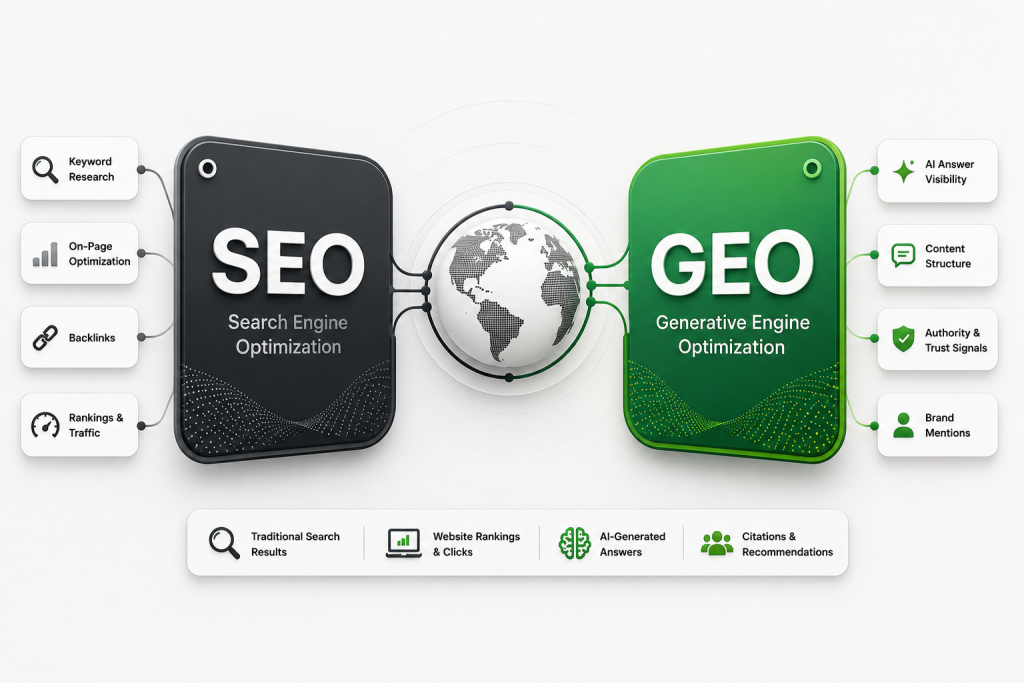
Search is splitting into two experiences: the classic list of blue links, and the AI answer that speaks before any link is clicked. Here is how GEO and SEO actually differ, what the data says, and how to decide where to invest.
SEO improves your visibility in conventional search by helping engines crawl, understand, rank and display your pages. GEO, or Generative Engine Optimization, improves the probability that AI systems will retrieve, understand, trust, summarize and cite your information in generated answers. Most businesses need both: SEO creates eligibility and authority; GEO makes that authority easier for answer engines to use.
The simplest way to understand the two disciplines is to look at the result each one is trying to produce.
SEO is the practice of improving a website so search engines can discover its pages, understand their meaning and rank them for relevant searches. Its visible outcomes include organic rankings, featured snippets, map visibility, product results, image visibility and qualified clicks.
SEO includes technical health, search-intent research, content quality, internal linking, digital authority, page experience and conversion optimization.
GEO is an industry term for improving how a brand, website or piece of information appears in AI-generated responses. The target is not only a ranked link. It may be a citation, source card, attributed fact, product suggestion, local-business mention or recommendation.
GEO emphasizes extractable answers, verifiable claims, consistent entities, first-party evidence, accessible source content and coverage of the questions an AI system may research while constructing an answer.
The central difference is the visibility event you are optimizing for.
A search engine decides that your page is one of the most relevant results for a query. It displays your title, URL and snippet, or another search feature, and the user decides whether to click.
Primary goal: earn prominent placement, qualified traffic and conversions.
An answer engine retrieves information from one or more sources, uses those sources to construct a response and may reference your page or brand as evidence.
Primary goal: become a trusted input to the answer and receive visible attribution, recommendation or referral traffic.
AI-generated answers are becoming a meaningful discovery layer, but current evidence supports an integrated strategy rather than abandoning organic search.
Those figures create an important tension. AI interfaces are growing quickly, yet organic search remains vastly larger. Semrush's channel study says organic search generated more than one trillion visits in 2025, while AI referral traffic remained a very small share of total web visits. The strategic response is therefore coverage across both discovery paths, not a rushed migration from SEO to GEO.
Google's current guidance says its generative AI features, including AI Overviews and AI Mode, are rooted in core Search ranking and quality systems. Google describes retrieval-augmented generation as using its search systems to retrieve relevant, current pages, and describes "query fan-out" as running related searches to gather information for a more complete answer.
Google acknowledges GEO and AEO as common industry terms, but from its own Search perspective, optimization for generative experiences remains part of optimizing the search experience. The practical conclusion is not that GEO is useless. It is that GEO cannot be separated from indexing, relevance, quality and trust.
llms.txt file for Google rankings or generative Search inclusion; Google currently says it ignores the file for Search.Google instead emphasizes valuable non-commodity content, clear technical structure, useful organization, strong images and video when relevant, accurate local or product data, and a satisfying page experience.
SEO is much broader than inserting keywords. It creates the conditions under which a search engine can confidently find, understand, rank and present your pages.
Crawlable URLs, correct canonicalization, sensible redirects, mobile usability, fast delivery, indexable text, clean status codes and internal links expose your important pages to search systems. This is the core of any technical SEO program.
A page must solve the searcher's problem more completely than alternatives. Strong content matches intent, covers necessary subtopics and adds useful information beyond a generic summary.
Depending on the query, links, brand references, reviews, author expertise, source quality, consistency and historical performance help engines judge whether a page deserves visibility.
A successful SEO program turns these foundations into relevant impressions, stronger positions, engaged organic sessions, leads and revenue. The same foundations also make a site more useful as a source for generative systems.
No public checklist can guarantee that a platform will cite a specific page. Models, indexes, freshness systems and interfaces differ. The following qualities, however, make a page more useful for retrieval and attribution, and they sit at the heart of modern AI SEO services.
Place a clear, self-contained answer near the heading that introduces the question. Follow it with evidence, conditions, examples and deeper explanation so a system does not need to guess the passage's context.
Separate facts from opinions. Cite primary sources for changing claims. Include dates, methodology, limitations and the origin of data. Unsupported superlatives are difficult to trust.
Use one consistent business name, service description, location, author identity and contact profile. Connect organization and author pages. Structured data can reinforce meaning when it accurately matches visible content.
Add something competing pages do not: original research, first-hand experience, a tested framework, expert commentary, diagrams, templates, calculations or transparent decision criteria.
Important information should be available in readable HTML and not trapped behind blocked scripts, login walls or inaccessible interfaces. OpenAI says public sites can appear in ChatGPT Search and provides OAI-SearchBot controls for publishers.
A business is easier to trust when its essential facts are consistent across its website, profiles, reputable directories, reviews, industry publications and other independent sources.
Instead of treating SEO and GEO as separate silos, this framework organizes both around five conditions that must work together.
| Area | SEO | GEO |
|---|---|---|
| Main outcome | Ranked result, search feature, visit or conversion | Citation, source link, attributed fact, mention or recommendation inside an AI answer |
| Primary interfaces | Google and Bing results, Maps, images, shopping and other search surfaces | AI Overviews, AI Mode, ChatGPT Search, Copilot, Perplexity and other answer interfaces |
| Query pattern | Keyword-led, navigational, local, transactional and informational searches | Conversational, comparative, multi-step and context-rich research prompts |
| Content unit | The page and its relationship to the wider website | The page plus the specific passage, fact, entity or evidence retrieved from it |
| Technical dependency | Crawlability, rendering, indexing, canonicalization and internal architecture | The same foundation, plus readable source content and platform-specific crawler access where relevant |
| Authority signals | Links, reputation, expertise, reviews, relevance and historical trust | The same signals, with added emphasis on corroboration, attribution and claim-level support |
| On-page style | Intent-focused, comprehensive, readable and easy to navigate | Answer-first, evidence-backed, entity-clear and safe to quote without distortion |
| Typical metrics | Impressions, positions, CTR, organic sessions, leads and revenue | Citations, cited pages, grounding queries, AI referrals, brand mentions and assisted conversions |
| Guarantee possible? | No ranking, traffic or revenue outcome can be guaranteed | No citation, mention or recommendation can be guaranteed |
For most established businesses, the answer is both. The sequence and budget allocation depend on the condition of your current website.
In this position, a GEO-only campaign is premature. Fix eligibility, relevance and trust before focusing heavily on citation extraction.
Here, GEO can help convert existing search authority into broader visibility across answer engines.
| Business type | Recommended approach | Reason |
|---|---|---|
| New website | SEO foundation with GEO-ready writing | Build crawlability, service coverage and authority while using clear answers and evidence from day one. |
| Established B2B company | Integrated SEO + GEO | Buyers use detailed comparisons and vendor-shortlisting questions that suit generative research. |
| Local service business | Local SEO first, then local GEO | Profiles, reviews and consistent business information provide the verification layer for local AI recommendations. |
| Ecommerce brand | Technical/product SEO + product GEO | Clean product data, reviews, comparisons and accurate availability support both search listings and AI-assisted shopping research. |
| Publisher or knowledge site | Strong combined program | Fresh, original and well-sourced pages need both search discovery and citation visibility. |
| Brand with stable impressions but falling clicks | Protect SEO and expand GEO measurement | The issue may be changing interfaces or query mix, not simply weaker rankings. |
A combined program should not create two competing content calendars. Every strategically important page should be strong enough to rank and clear enough to become a source.
If you are not sure where your site stands today, a structured SEO audit is the fastest way to establish these baselines before the work begins.
Measurement is becoming more practical. Google's current documentation points site owners to a generative AI performance report in Search Console where available. Bing Webmaster Tools' AI Performance dashboard reports total citations, cited pages, grounding-query samples and trends across supported Microsoft AI experiences. OpenAI says ChatGPT referral links include utm_source=chatgpt.com, allowing publishers to identify click-through traffic in analytics.
Without crawlability, indexing, relevance and authority, there is little for a retrieval system to work with. GEO should extend a functioning SEO program.
Google recommends unique, non-commodity content and warns that scaled content produced without added user value may violate spam policies.
Include dates, sources, methodology and limitations. A polished chart is not evidence unless the underlying numbers can be verified.
Structured data should describe visible information accurately. More markup is not automatically better, and no special GEO schema guarantees citations.
Your own website cannot independently validate every brand claim. Reviews, relevant publications and consistent profiles help corroborate identity and reputation.
A citation can improve awareness but still deliver little commercial value. Track whether visibility produces qualified visits, demand, leads or revenue.
Choose SEO as the foundation and GEO as the extension.
SEO makes your website discoverable, indexable, relevant and competitive. GEO makes your strongest information easier for generative systems to retrieve, verify and cite. A business that invests only in SEO may rank but remain absent from some AI answers. A business that invests only in GEO may publish perfectly formatted passages that lack the authority or technical eligibility to be discovered.
The winning 2026 strategy is one integrated search program: technically sound pages, original expertise, clear answers, trustworthy evidence, consistent entities, independent authority and measurement across both clicks and citations.
No. GEO is not replacing SEO. Generative systems still need accessible, relevant, and trustworthy source material. SEO creates that foundation, and GEO improves how easily information can be retrieved, understood, verified, and cited inside generated answers.
Only in limited or inconsistent ways. A brand may be mentioned because of third-party sources even when its own site is weak, but durable visibility usually requires crawlability, indexing, topical relevance, authority, and accurate entity information.
SEO targets visibility in conventional search results. AEO focuses on clear direct answers for answer surfaces such as featured snippets and voice experiences. GEO is the broader practice of improving citation and recommendation visibility in generative answers. The disciplines overlap heavily.
Not an artificial style written only for machines. Useful GEO content tends to provide clear answers, descriptive headings, strong evidence, and unambiguous context. These practices also improve human readability and traditional SEO.
There is no universal GEO ranking and no special schema that guarantees an AI citation. Accurate structured data can help systems understand entities and may support search features, but it must match the visible page.
Google’s current guidance says Google Search does not use llms.txt as a special ranking or generative-visibility mechanism. You may maintain it for other systems that choose to use it, but Google says it neither helps nor harms Search visibility.
OpenAI says public websites can appear in ChatGPT Search. Review OAI-SearchBot access for pages you want discoverable and ensure important content is public, readable, and technically accessible. GPTBot is a separate user agent connected to model-training preferences.
Yes, in the right sequence. First secure technical health, service and location coverage, reviews, profile accuracy, and local authority. Then improve direct answers, evidence, comparisons, and consistent entity signals to strengthen recommendation visibility.

Compare the 8 best SEO companies in San Antonio for 2026. See who each agency fits, their specialties, and how to choose the right partner for your business.

How much does SEO cost in San Antonio? Most local businesses pay $1,500 to $3,000/mo. See full 2026 pricing by industry, model, and when it pays off.

Cyfrow Solutions is now a top-rated SEO agency on Clutch with 34 verified five-star reviews. Read about our SEO results across industries.

How to choose an SEO company that fits your goals and budget. Learn what to ask, what to skip, and which SEO red flags to watch out for.